
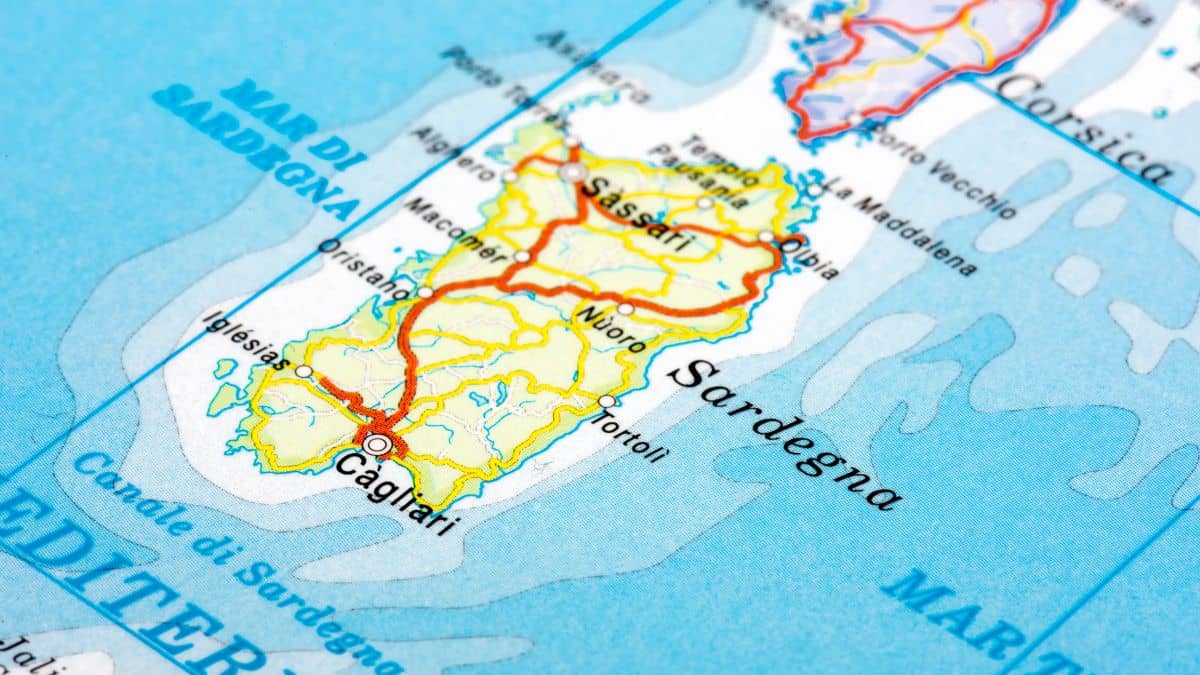

Sardinia is often considered just a summer holiday destination, known for its beautiful beaches, which are among the best in the world. However, this region also has a wilder side, featuring rugged promontories, karst sinkholes, caves, and archaeological sites that evoke the ancient times of the Nuragic civilization.
Get ready for a trip that will be a true feast for your eyes!
Start from Olbia towards Orosei
Sardinia is a large island with a historical, artistic, and natural heritage that deserves to be discovered in every corner, including those less trodden by tourist routes.
If you pick up your rental vehicle from Olbia Costa Smeralda Airport, Olbia must be your starting point: the city of Gallura bears the marks of its long history, which you will notice when you see the massive Punic walls, the remains of a Roman forum, and the ruins of an aqueduct built between the 2nd and 3rd centuries AD.
Before leaving Olbia, visit the Pedres Castle located near the Su Monte ‘e S’Abe giant’s tomb, one of the most spectacular Nuragic burials on the island.
Start your Sardinia road trip and, traveling along the eastern coast, reach San Teodoro: take the Trenino Teodorino, which will take you to the town center and its most beautiful beaches, including La Cinta, located in front of the island of Tavolara.
Get off the train and board a boat to visit the Lagoon of San Teodoro, home to flamingos, herons, and cormorants.
Continue south to Budoni, where you can stop for a taste of the real Gallura soup, then head to the Gulf of Orosei, one of the most iconic and spectacular places on the island. Put on your swimsuit and comfortable shoes, as you will need to hike along winding trails to reach paradisiacal beaches like Cala Mariolu, which was once frequented by the monk seal, Cala Goloritzè with the pointed Monte Caroddi towering above it, and Cala Luna, located near the beautiful Bue Marino Cave.
From Dorgali to Santa Margherita di Pula
From nearby Cala Gonone, a small village where a visit to the Aquarium is worth it, showcasing numerous marine species from the Tropics and the Amazon, drive towards Dorgali. From here, you can discover the Garropu Canyon, one of the deepest and most scenic in Europe, and most notably Tiscali, the extraordinary Nuragic village developed in the 6th century BC inside a doline in Supramonte: to reach it, you will need to walk along an ancient path, between rocky walls, birds of prey flying overhead, and deafening silence.
The Sardinian tour continues in the heart of the Gennargentu: take a few days to visit this area, walking through the lush Montes Forest and hiking in the Giara Nature Reserve, where you can admire wild horses wandering among arbutus, oaks, and ponds.
Get back in the car and head to Barumini, where Su Nuraxe, the Nuraghe (one of the three most beautiful Nuraghes of Sardinia) dating back to 1500 BC, stands, a UNESCO World Heritage site: you won’t have trouble spotting the remains of the village around the central tower, the walls, and the small towers, all built in basalt.
Passing through Senorbì, the ancient granary of Rome, reach Cagliari, in the southernmost part of Sardinia: relax while strolling towards the Bastione di Saint Remy or in the historic Castello district, where important historical sites such as the towers of San Pancrazio and the Elephant, and the 13th-century Cathedral can be found, inside which there is an underground sanctuary with the relics of 179 martyrs. In the Archaeological Museum, you can admire Nuragic artifacts such as the majestic Mont’e Prama statues and the Egyptian god sculpture of Bes.
Continue the tour towards Santa Margherita di Pula, where, besides the 12th-century Church of Sant’Efisio, the remains of the ancient Phoenician city of Nora can be found, where performances such as “The Night of the Poets” are still held in the Roman amphitheater every July.
Final Stop
Drive up the western coast of Sardinia, passing Sant’Antioco, a town developed on an island connected to the mainland by a bridge, and home to the island’s oldest Byzantine church, before reaching Iglesias in the heart of Sulcis Iglesiente. Here, you will find a geomineral park declared a UNESCO World Heritage site, with its main symbol being Porto Flavia, an incredible feat of engineering that, with the construction of a gap overlooking the sea, sped up the unloading of minerals extracted directly into the sea.
Drive towards Oristano while passing through the beautiful Costa Verde and stop at Piscinas: you won’t regret it because you’ll find yourself in front of a desert-like area facing the sea, with deserted beaches and long dunes caressed by the winds.
One of the must-see stops on your itinerary is Bosa, one of the most beautiful villages in Italy, with colorful houses along the banks of the Temo River, ancient tanneries, and the old stone bridge. The Malaspina Castle towers over Bosa from above, full of history and legends, and it is whispered that it is haunted by the ghostless specter of Countess Malaspina, tormented by her jealous husband.
Along the Coral Riviera, Alghero appears, situated just steps away from the Capo Caccia Natural Marine Area and Piana Island: stop by the city and visit the beautiful Cathedral of Santa Maria with its majolica dome and the Coral Museum.
Your journey is about to end, but not before visiting Stintino with the adjacent Asinara National Park, the Pelosa beach, and the picturesque Castelsardo, where you can visit the Doria Castle and the Basketry Museum, which showcases handcrafted items made from the ancient weaving of fibers and plant leaves. And of course, don’t miss the stunning beaches of Castelsardo!
After passing the scenic Capo Testa promontory, from which you can admire the Strait of Bonifacio and Corsica, reach Santa Teresa di Gallura, the gateway to the northeastern coast.
Finish your trip by sailing from the small port of Palau to the Maddalena Archipelago (find out how to get there by car), where you can enjoy the crystal-clear sea from the Pink Beach in Budelli, Cala Francese, and Cala Spalmatore.
To explore the region freely and independently, the best option is to rent a car from Olbia Airport. At Ellepi Rental Agency, you can pick up your car or scooter in no time, paying even in cash or choosing the payment method that suits you best.
The Car Fleet is vast and constantly updated, offering small cars, sedans, minivans, or SUVs, all checked so that you don’t have to worry about anything but getting behind the wheel and driving along Sardinia’s winding roads.
Book your car at Ellepi Rental Agency at Olbia Costa Smeralda Airport and travel all over Sardinia in safe, well-maintained vehicles!