
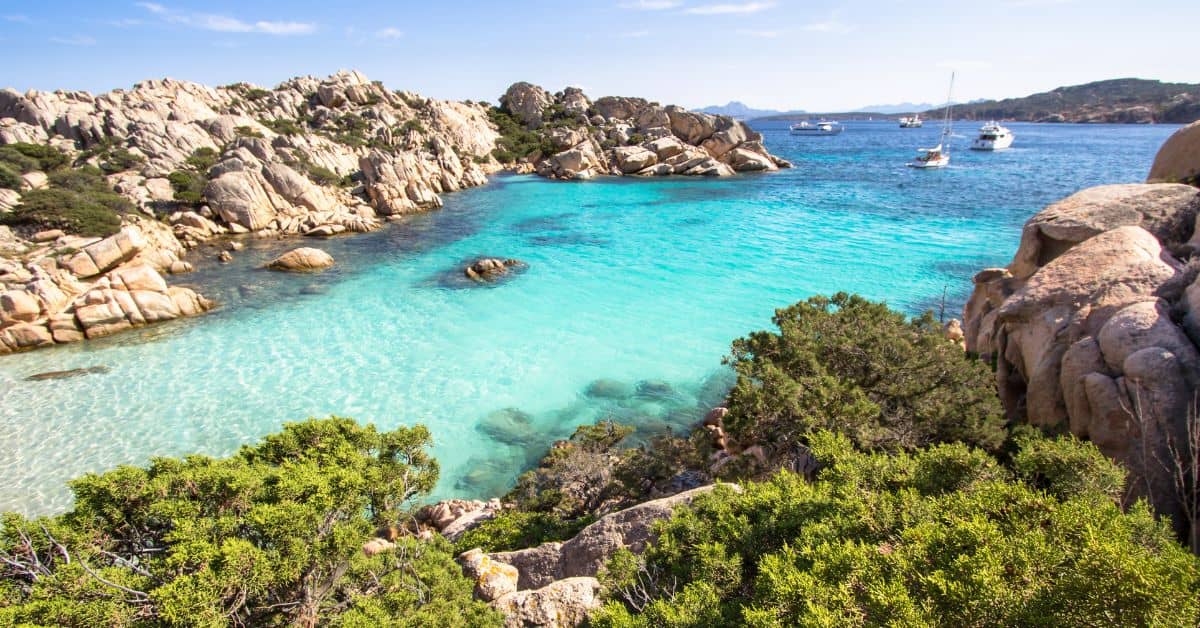

When you think of Sardinia, one of the first images that comes to mind is that of white-sand beaches overlooking crystal-clear turquoise waters.
That image is not exaggerated: in many parts of the island, the scenery genuinely recalls tropical destinations, with pale seabeds, transparent water, fine sand or small white pebbles, and bays surrounded by Mediterranean vegetation.
However, Sardinia’s so-called Caribbean-style beaches are not concentrated in a single area. Some are just a short drive from Olbia, while others are located along the Costa Smeralda, in the Gulf of Orosei, in the far north-west or along the southern coast.
For this reason, if you want to discover more than one during the same holiday, having a car is particularly useful. You can reach beaches that are accessible by road, travel between areas that are far apart and get to the ports from which boat trips depart for coves that can only be reached by sea.
If you arrive in north-eastern Sardinia, you can rent a car at Olbia Airport and plan an itinerary that combines famous beaches, more secluded coves and full days dedicated to boat excursions.
So, let’s take a look at which beaches in Sardinia most resemble the Caribbean, where they are located and how to plan your visit.
Which are the most Caribbean-style beaches in Sardinia?
The best choice depends on the type of landscape you are looking for.
If you want very white sand and shallow water, Cala Brandinchi, Porto Istana and La Pelosa are among the best examples.
If you prefer wild coves surrounded by high cliffs, the Gulf of Orosei offers Cala Goloritzé, Cala Mariolu and Cala Luna.
For tropical-looking water surrounded by nature, Berchida is an excellent choice, while in southern Sardinia Tuerredda, Porto Giunco and Cala Sinzias are among the most spectacular destinations.
On the Costa Smeralda, meanwhile, Spiaggia del Principe combines postcard-perfect scenery with an itinerary that is easy to organise from Olbia.
Porto Istana: turquoise water just minutes from Olbia
If you land in Olbia and want to see postcard-perfect sea straight away, Porto Istana is one of the easiest beaches to reach.
The bay lies within the municipality of Olbia, at the foot of Capo Ceraso, and is around twenty minutes by car from the city. It is made up of four small beaches separated by rocky sections, all characterised by very fine white sand and a seabed that slopes gently into the water.
The unmistakable profile of Tavolara Island rises offshore, giving the landscape a particularly distinctive character.
The sea ranges from turquoise to emerald green and, thanks to the shallow seabed, Porto Istana is also particularly popular with families.
It is one of the best choices if you want to start your holiday with a spectacular beach without travelling far.
Cala Brandinchi: the “Little Tahiti” near San Teodoro
Among the most famous beaches in north-eastern Sardinia is Cala Brandinchi, in the municipality of San Teodoro.
Its nickname, “Little Tahiti”, comes directly from the appearance of the bay: very pale sand, transparent water and an extremely shallow seabed extending for many metres, with Tavolara Island visible on the horizon.
The beach is surrounded by Mediterranean vegetation and a pine forest, which adds to the beauty of the setting.
Advance booking is required
From 1 June to 30 September, access to Cala Brandinchi is subject to mandatory advance booking.
Bookings open every day at 6:00 pm for the second following day, and access is managed via QR Code. During the busiest periods, available places can sell out quickly, so it is important to plan ahead.
If you are staying in Olbia, Cala Brandinchi is one of the easiest day trips to organise by car, perhaps combining it with Lu Impostu or an evening in San Teodoro.
Spiaggia del Principe: the turquoise heart of the Costa Smeralda
Spiaggia del Principe is one of the symbolic beaches of the Costa Smeralda.

It lies in a deep bay protected by pink granite headlands and owes its name to Prince Karim Aga Khan, who played a major role in the tourism development of the area and reportedly considered it one of his favourite beaches.
The beach is made up of pale sand and the sea shifts from turquoise to emerald green.
To reach it, you need to walk a short distance from the parking area, but the access route does not involve a demanding hike.
It is a perfect stop on a driving itinerary that includes San Pantaleo, Porto Cervo and the beaches of the Costa Smeralda.
Cala Coticcio: Caprera’s Tahiti
On the island of Caprera, in the La Maddalena Archipelago, lies Cala Coticcio, often nicknamed “Tahiti” because of the colour of the water and the contrast with the granite rocks.
It is a small cove enclosed by headlands and characterised by transparent water, a pale seabed and pinkish rocks.
However, a visit by land should not be improvised.
Cala Coticcio lies within an area subject to strict environmental protection, and hikes along the trail require prior authorisation from the National Park and must be carried out with authorised environmental hiking guides. In 2026, the Park confirmed specific procedures for guided visits to the area.
If you are travelling from Olbia, you can reach Palau by car, take the ferry with your vehicle to La Maddalena and continue towards Caprera, or join an organised boat excursion.
Budelli’s Spiaggia Rosa: a paradise to admire without touching
The La Maddalena Archipelago is also home to one of the most unusual beaches in the Mediterranean: Budelli’s Spiaggia Rosa, or Pink Beach.
The colour of the sand comes from bioclasts, including fragments of bryozoans and foraminifera such as Miniacina miniacea, which contribute to its distinctive pink hue.
This place must, however, be treated differently from the other beaches in this guide.
Spiaggia Rosa is under full environmental protection: access to the beach, swimming, navigation, anchoring and stopping boats in the stretch of sea directly in front of it are prohibited.
The Park has created a walkway that allows visitors to admire the beach from a distance without damaging the environment.
Budelli should therefore be included in a day in the Archipelago not as a beach where you spend a few hours swimming, but as one of Sardinia’s most delicate and iconic natural landscapes.
Berchida: five kilometres of sand and transparent sea
If you are looking for a spectacular beach that is much larger than the island’s small coves, Berchida is one of the best alternatives.
It lies in the municipality of Siniscola, along the north-eastern coast, and forms a long crescent of around five kilometres with pale sand, dunes, juniper bushes and water in shades of green and turquoise.
The seabed remains shallow and the large size of the beach makes it easier to enjoy a more relaxed atmosphere than at some of Sardinia’s smaller and more crowded famous beaches.
Berchida is particularly well suited to a day exploring the coast between Siniscola and Orosei and can be included in a driving itinerary south from Olbia.
Cala Luna: sand, caves and limestone cliffs
In the Gulf of Orosei, on the border between the territories of Dorgali and Baunei, lies Cala Luna.
The beach is around 800 metres long and is framed by high rocky cliffs. Large natural caves open behind the beach, creating one of the most distinctive landscapes in the entire gulf.
The sea is clear and the seabed becomes deeper relatively quickly, making the area interesting for snorkelling and diving as well.
Cala Luna can be reached by sea from Cala Gonone, Arbatax or Santa Maria Navarrese, or via hiking trails that require proper preparation and planning.
A car is therefore especially useful for reaching the departure port or trailhead and planning a full day dedicated to the coves of the Gulf of Orosei.
Cala Mariolu: a sea that looks almost painted
If we had to choose one of the beaches that best justifies the phrase “the Caribbean in Sardinia”, Cala Mariolu would certainly be near the top of the list.
The cove is located in the territory of Baunei and is covered with small white and pink pebbles, known locally as is pùligi de nie, meaning “snow fleas”.
The sea ranges from bright blue to emerald green and is surrounded by cliffs that rise hundreds of metres above the water.
How to get there
By land, Cala Mariolu can be reached via a demanding trek suitable for experienced hikers.
For most visitors, the easiest option is to arrive by sea, with boat services departing from Santa Maria Navarrese, Arbatax or Cala Gonone.
A boat trip can also include other coves in the Gulf of Orosei, turning the journey itself into one of the highlights of your holiday.
Cala Goloritzé: the natural monument of the Gulf of Orosei
Cala Goloritzé is one of Sardinia’s most spectacular beaches.
It lies in the territory of Baunei and is instantly recognisable thanks to the Punta Caroddi limestone pinnacle, the natural rock arch along the coast and the extraordinarily transparent water.
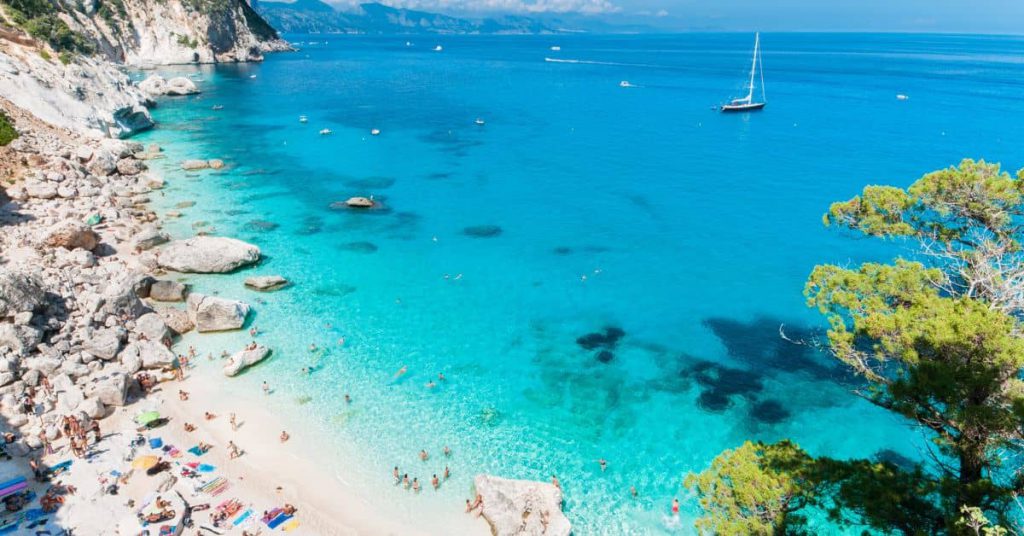
The shoreline is mainly made up of small pale pebbles, and the sea can feel particularly cool even in summer because of freshwater springs.
By land, it is reached via the trail starting from the Golgo Plateau. The route is around three and a half kilometres each way, but it involves a significant elevation change and requires suitable footwear and adequate preparation.
If you are staying in north-eastern Sardinia, driving to Baunei allows you to plan a proper excursion in Ogliastra and discover some of the most beautiful beaches in the area.
La Pelosa: shallow water and tropical colours
In Stintino, at the far north-western end of Sardinia, lies La Pelosa, one of the island’s most famous beaches.
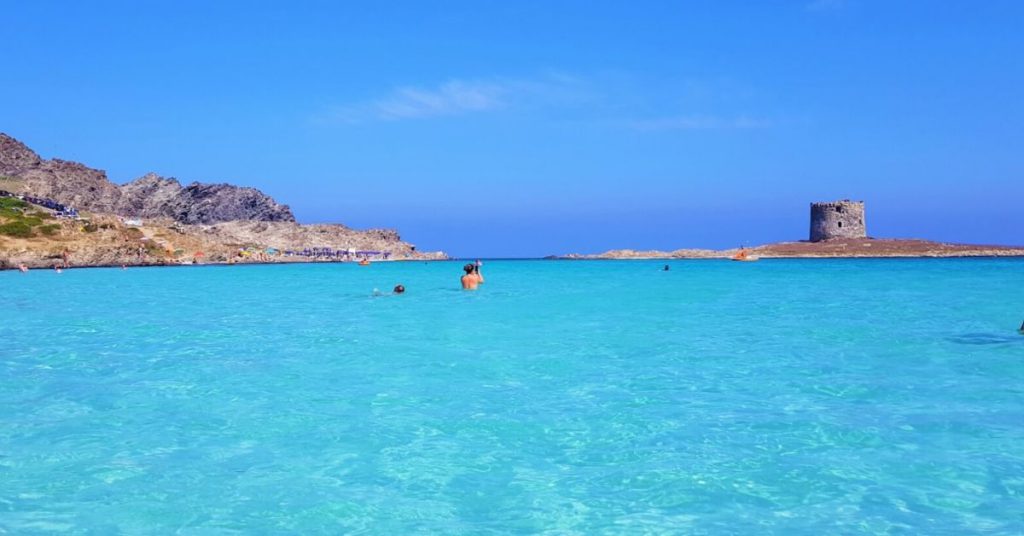
Its most distinctive feature is its almost tropical appearance: very fine sand, extremely shallow water extending for many metres and colours ranging from pale blue to turquoise and deep blue.
The characteristic 16th-century tower stands just offshore, while Piana Island and Asinara complete the unique setting.
During periods when regulated access is in force, it is necessary to check booking procedures and access rules in advance on the official beach website.
If you are travelling from Olbia, La Pelosa requires a fairly long drive, so it is better included in an itinerary dedicated to north-western Sardinia, perhaps combining Stintino with Alghero or Asinara.
Porto Giunco: turquoise sea and flamingos in Villasimius
In south-eastern Sardinia, in Villasimius, lies Porto Giunco, one of the most scenic beaches in the Capo Carbonara Marine Protected Area.
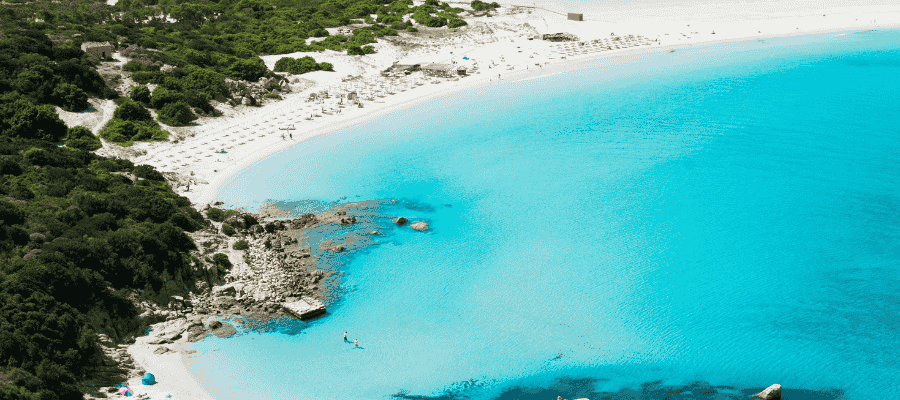
The beach is characterised by pale sand, turquoise water and a transparent seabed, while the Notteri lagoon lies directly behind it.
One of the best ways to appreciate the landscape is to walk up to the Porto Giunco tower, built in the 16th century. From the headland, you can see the sea, the long beach and the wetland area visited by flamingos all at once.
Cala Sinzias: two kilometres of white sand
Around 15 kilometres from Villasimius lies Cala Sinzias, in the municipality of Castiadas.
It is a long beach of around two kilometres, with fine, very pale sand and clear sea in intense shades of blue.
Unlike many of Sardinia’s famous small coves, Cala Sinzias offers space, facilities and a wide beach, making it suitable for visitors who want to spend the entire day by the sea.
Parking, beach facilities, bars and restaurants are available, and the beach is also accessible to people with disabilities.
It is a good choice if you want spectacular water without giving up convenience.
Tuerredda: the tropical jewel of south-western Sardinia
In the municipality of Teulada lies Tuerredda, one of the Sardinian beaches most frequently compared to the Caribbean.
It stretches for more than half a kilometre inside a bay between Capo Malfatano and Capo Spartivento and is characterised by very fine sand and intensely blue water.
To reach it, you drive along the scenic SP71 Costa del Sud road, which passes through around 25 kilometres of particularly beautiful coastal scenery.
Tuerredda is very popular during the high season, so it is always advisable to check current access rules and parking availability before setting off.
If you are touring southern Sardinia, it can easily be combined with the beaches of Chia and the other coastal destinations around Teulada.
Which Caribbean-style beach should you choose?
Not all of these destinations offer the same type of experience.
If you want a beach close to Olbia, choose Porto Istana.
For a day of shallow water and very fine sand, Cala Brandinchi is one of the best choices.
For the Costa Smeralda, choose Spiaggia del Principe.
If you want to spend a day in the La Maddalena Archipelago, Cala Coticcio is one of the most fascinating destinations, while Budelli should be experienced as a natural site to admire and protect.
If you are looking for wild beaches and spectacular cliffs, choose the Gulf of Orosei, with Cala Mariolu, Cala Goloritzé and Cala Luna.
For a large beach surrounded by nature, Berchida is one of the best options.
In southern Sardinia, Porto Giunco, Cala Sinzias and Tuerredda can be combined into a real itinerary dedicated to some of the island’s clearest waters.
The best beaches for families
For families travelling with young children, seabed depth and accessibility are important factors.
Porto Istana is particularly suitable because the seabed slopes gently.
Cala Brandinchi also has shallow water for a long stretch, although advance booking is required during the regulated access period.
Berchida offers plenty of space and shallow water, while Cala Sinzias combines facilities with a very large beach.
Cala Goloritzé and Cala Mariolu, on the other hand, require more planning and are less suitable if your priority is simply to enjoy an easy beach day with small children.
Which beaches require advance booking or an organised visit?
This is one of the main things to check before setting off.
Cala Brandinchi requires advance booking from 1 June to 30 September.
Cala Coticcio, when reached via the trails within the protected area, requires an authorised visit with an environmental hiking guide.
Budelli – Spiaggia Rosa is not accessible as a normal bathing beach: both the shoreline and the stretch of sea directly in front of it are under full environmental protection.
For La Pelosa, Tuerredda and other beaches subject to seasonal restrictions, it is always advisable to check the latest rules for the year of your visit, as access systems, fees and operating periods may change.
How to plan a trip around Sardinia’s most beautiful beaches
Trying to see all of these beaches in just a few days would be unrealistic.
The best solution is to divide the island into geographical areas.
North-east: the easiest beaches to reach from Olbia
You can plan an itinerary between:
Olbia → Porto Istana → Cala Brandinchi → Costa Smeralda
and dedicate a second day to:
Olbia → Palau → La Maddalena Archipelago.
This is probably the best option if you land in Olbia and only have a few days available.
East coast and Gulf of Orosei
To explore Cala Luna, Cala Mariolu and Cala Goloritzé, it is best to base yourself around Cala Gonone, Baunei, Santa Maria Navarrese or Arbatax, depending on the excursion you choose.
The car is therefore mainly useful for reaching the base, port or trailhead from which your day on foot or by boat begins.
North-west
For La Pelosa, you can plan an itinerary such as:
Stintino → Asinara → Alghero
and dedicate at least one or two days to this part of the island.
South and south-east
In southern Sardinia, you can divide your trip between:
Villasimius → Porto Giunco → Cala Sinzias
and, on a different day:
Chia → Tuerredda → Teulada coast.
This way, you avoid excessive driving and can actually enjoy the beaches rather than spending most of the day on the road.
Why having a car lets you see much more
In Sardinia, the most spectacular beaches are not all located close to the main towns and cities.
Some require scenic drives, others can only be reached after leaving the car and continuing on foot, while others require you to reach a port and continue by boat.
Travelling by car allows you to reach excursion departure points, change destination during the day, visit beaches with limited public transport and build a trip across very different parts of the island.
If you arrive in Olbia, you can browse our rental car fleet and choose a vehicle that suits your itinerary.
Frequently asked questions about Sardinia’s Caribbean-style beaches
What is the most Caribbean-style beach in Sardinia?
There is no single answer. Cala Brandinchi and La Pelosa are among the beaches that most resemble a tropical setting because of their sand, shallow water and colours. Cala Mariolu and Cala Goloritzé offer a wilder and more dramatic landscape.
Which Caribbean-style beaches are closest to Olbia?
Porto Istana is one of the closest. Cala Brandinchi and the beaches of the Costa Smeralda are also easy to reach by car from north-eastern Sardinia.
Where can you find the clearest sea in Sardinia?
Exceptionally clear water can be found in many parts of the island. The La Maddalena Archipelago, Costa Smeralda, Gulf of Orosei, San Teodoro, Villasimius and the Teulada coast are among the best-known areas.
Which is better, Cala Brandinchi or La Pelosa?
Cala Brandinchi is much more convenient if you are staying in the north-east and arriving through Olbia. La Pelosa is located in the far north-west and requires a dedicated itinerary towards Stintino.
Which beaches can I visit without taking a boat?
Porto Istana, Cala Brandinchi, Spiaggia del Principe, Berchida, La Pelosa, Porto Giunco, Cala Sinzias and Tuerredda can all be reached by land.
Cala Goloritzé can also be reached on foot via a hiking trail.
For Cala Mariolu and Cala Luna, a boat is often the most practical option, while access by land to Cala Coticcio is regulated.
How many days do you need to see Sardinia’s most beautiful beaches?
To visit beaches in different parts of the island without spending your entire holiday driving, it is advisable to allow at least one week and focus on two or three geographical areas.
With three or four days, it is better to concentrate on a single area, for example north-eastern Sardinia starting from Olbia.
A journey through some of the Mediterranean’s most spectacular waters
Sardinia does not have just one “Caribbean-style beach”.
Its real appeal lies in its variety: you can go from the fine sand of Cala Brandinchi to the white pebbles of Cala Mariolu, from the extremely shallow waters of La Pelosa to the cliffs of Cala Goloritzé, all the way to the bays of southern Sardinia and the islands of the La Maddalena Archipelago.
The best way to experience them is not to rush from one beach to another, but to plan your trip by area and give each stretch of coastline the time it deserves.
If you want to start from north-eastern Sardinia, you can book your rental car with Ellepi and use Olbia as your starting point for discovering some of Sardinia’s most spectacular beaches.
Sardinia's Most Charming Caribbean-Style Beaches