

Milford Sound, the Great Ocean Road and the Pacific Coast Highway are among the most scenic roads in the world, located in the USA, Australia and New Zealand.
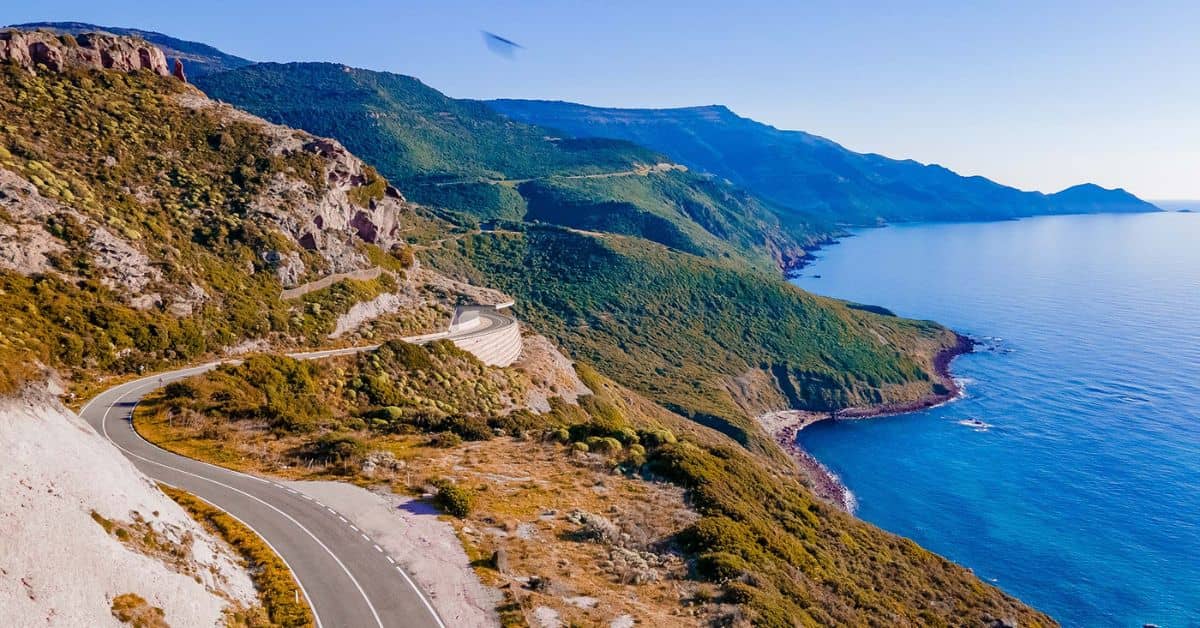
Yet Italy also has routes that feel just as surprising. Some are little known, but no less thrilling: one of them is in Sardinia, and it is Provincial Road 49, linking the city of Alghero to the town of Bosa.
Even Touring Club Italia has mentioned it as a must-do stop on a trip to Sardinia, thanks to the natural setting it crosses—wild, striking, and deeply connected to the island’s identity.
Hiring a car at Olbia Airport, around 137 km from Alghero, and relying on the professional Ellepi car hire team, is the best way to discover this corner of Sardinia with total freedom and autonomy—Kerouac style—on comfortable, safe vehicles that receive regular maintenance.
What to see along the road between Alghero and Bosa
The SP49, which connects Alghero to Bosa in 49 km, is a winding ribbon along the sea. Waves break onto a sequence of beaches on one side, while on the other side rise trachyte rock faces covered in dense Mediterranean scrub.
Before you set off in the car you choose from the extensive Ellepi car fleet, take some time to visit Alghero and the Capo Caccia and Isola Piana Regional Natural Park.
In the lanes of the “little Barcelona”, where Catalan language and traditions still live on, you will find the glazed spire of the Cathedral of Santa Maria, the octagonal glazed dome of the 17th-century Church of San Michele, and the understated Church of Nostra Signora del Carmelo, built in 1644 in sandstone.
Alghero sits on the Riviera del Corallo, washed by waters whose seabed hosts red coral colonies. If you want to know more, visit the Coral Museum, dedicated to the marine ecosystem and the artefacts made from this precious material.
Treat yourself to a romantic walk along the city walls, built by the Doria family in the 12th century, among bastions and towers, including the oldest, Torre Sulis. Then enjoy local flavours: sea urchin spaghetti, Alghero-style lobster, biancomangiare, and a glass of Alghero DOC wine.
Get in the car and start the drive towards Bosa, passing Las Tronas Beach along Lungomare Valencia: a small stretch of sand at the foot of an Art Nouveau building converted into a hotel, with two throne-shaped rocks that explain the beach’s name.
Continue south to Colle Balaguer and you will reach Cala Bona, a cove that feels like a natural pool, with turquoise water and light, flat rocks that make a perfect sunbathing spot. The sea is usually calm and, if you love sport fishing or snorkelling, Cala Bona is an excellent choice.
Your next stop is considered one of the most beautiful beaches on the western Sardinian coast: Cala Burantinu, a cove of soft sand lapped by crystal-clear water that reveals shallow sandy seabeds. If you want more than a view from the road, you can reach it only on foot: park in the lay-by just beyond the Canal dell’Omo Molt and walk through broom, prickly pear, myrtle, strawberry tree and wild rosemary.
Along the way you will hear an enveloping silence, broken only by the sound of the sea, with Capo Caccia always on the horizon.
From Cala Burantinu, drive to the Spiaggia della Speranza in Poglina, a small seaside hamlet of Villanova Monteleone: the name recalls the nearby tower built by the Spanish to watch over this coastline.
The beach is set between Mediterranean scrub and a sea often shaped by mistral, libeccio and sirocco winds—no surprise that many surfers ride the waves at Spiaggia della Speranza.
On the way to Bosa via Villanova Monteleone
Before you continue along Provincial Road 49 by the sea, take a detour inland to Villanova Monteleone, the village where director Federico Fellini set scenes of “La Bibbia”. The town sits at 600 metres above sea level, not far from Lake Temo, and is known for basket weaving, textile craft, and the colourful murals across the historic centre. Some of the best are in Piazza Filomena Cherchi, dedicated to horses and everyday life.
A visit to the Sa Domo Manna Ethnographic Museum, housed in an 1800s building, offers a deeper look into local history through photographs, farming tools, household objects and artisan work.
Visit the 16th-century Church of San Leonardo da Limoges in Gothic-Catalan style, with two 18th-century wooden altars, then head to the Sanctuary of Nostra Signora di Interriors, also from the 16th century, with a beautiful bell tower above a portico.
Explore the area around Villanova Monteleone, starting with the Neolithic necropolis of Puttu Codinu, made of underground chambers decorated with bull horns carved into the walls, and above all the Monte Cucco Archaeological Park, home to the Nuraghe Appiu, plus dolmens and a hut village.
Back on the coastal road, drive under the shadow of Capo Marrargiu, a headland within a marine protected area that also includes the nearby Sa Pagliosa islet. Peregrine falcons, eagles and, above all, griffon vultures often glide overhead.
As you draw closer to the province of Oristano, the coastline becomes dotted again with beautiful beaches such as Cala di Torre Argentina, watched over by a 16th-century defensive bastion, Cala Cumpoltitu, a stunning emerald cove sheltered from the winds, and S’Abba Druche, whose shore mixes shells and pebbles.
End your journey in Bosa, one of the most picturesque towns in Sardinia. The Temo River runs through it, alongside the 11th-century country church of San Giorgio and the colourful historic las conzas along the banks. These former tanneries, developed between the 17th and 18th centuries, have been converted into homes and charming venues where you can enjoy a glass of Malvasia while admiring the riverside, the Ponte Vecchio, and the Temo flowing beneath it since the 12th century.
Bosa is overlooked by Serravalle hill, topped by Malaspina Castle. Reach this fortress, built in 1122, via a scenic staircase that starts from the Sa Costa Jewish quarter below. Beyond the castle—said to be haunted by the ghost of a marchioness killed by her jealous husband—you can also visit the 14th–15th century fresco cycle in the Church of Nostra Signora de sos Regnos Altos.